
It has become the (only) time of the year when everything stands still in China. Shops close, the streets lie empty, and the whole city sleeps. For a long time. Because it is Chinese New Year, and that means a holiday for virtually all Chinese people across the country. They head to the countryside, where grandparents gather the family around a lavish table from another world.
I’m riding on the back of Zephyr’s (my Chinese friend) motorcycle. The sun is shining, the breeze is warm, spring has arrived in China. We’re headed to a small village up in the mountains just outside the big city of Chongqing. This is where Zephyr’s grandmother and grandfather live. They run a small farm, where every spring they harvest and sell the Chinese plum ‘Pi Pa,’ also called ‘Loquat.’
But that’s not why the motorcycle is struggling to climb the winding mountain roads. We’ve loaded the two-wheeler with everything from oatmeal, milk, and cake to Anthon Berg chocolate and Danish honey as gifts for Zephyr’s grandparents — because we’re going up to celebrate Chinese New Year with her entire family.
Men and Women at Separate Tables
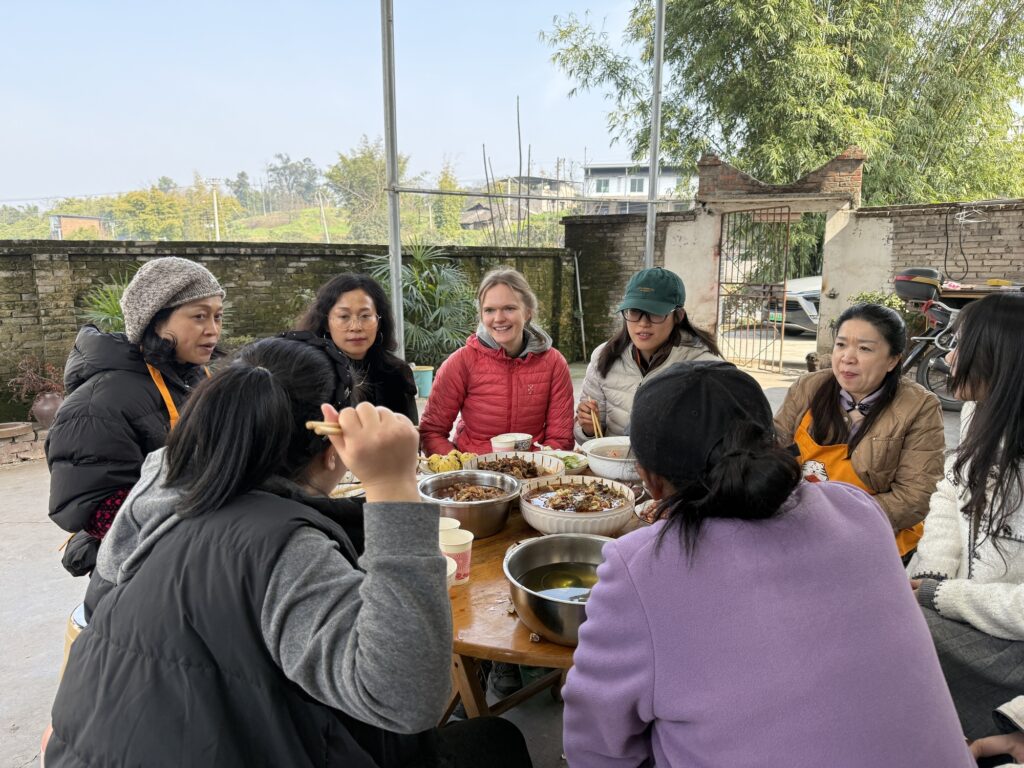
As we roll into the courtyard, grandmother, grandfather, mother, aunts, their husbands, and a bunch of children are ready with open arms to welcome us. The children jump and cling to me, and the women in the family compliment my blue eyes, prominent cheekbones, and light hair.
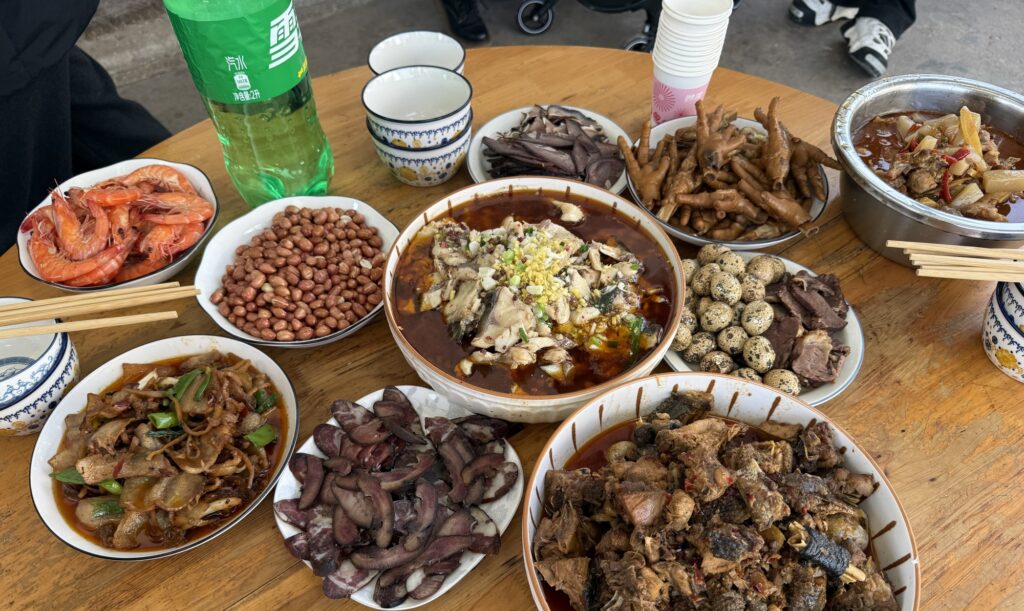
Meanwhile, the food is in full preparation in the dark stone kitchen next to the barn. Everyone helps — men as well as women. And with good reason, because every pot and pan is busy: rice dumplings with Sichuan pepper, fish soup, pork sausages, chicken feet, boiled lotus, bird liver, brown eggs, and a lot of other things I have no idea what are — all from the grandparents’ own crops and livestock.
“Help yourselves,” they say. The women sit at a round table outside in the courtyard, and the men sit inside what you would probably call a living room.
I ask Zephyr why they are separated by gender.
She says it’s just tradition. Those who drink alcohol and those who don’t sit at separate tables.
“So if I wanted to drink a beer, should I sit at the ‘men’s table’?” I ask.
Zephyr nods and laughs a little.
It doesn’t take long from the moment we sit down until the food is gone, and the floor is littered with bones and cartilage. The Chinese eat like vultures when hunger strikes. Waves of movement sweep across the table. Chopsticks reach across each other in all directions, and loud smacking sounds fill the air. Here, you shouldn’t worry too much about table manners. On the contrary, it seems rude to eat too little, too slowly, or too quietly, because grandmother “is watching you.” She immediately thinks that the food won’t suit your taste if you don’t shove it in as fast as possible.
Family Are Strangers With a Blood Bond
The Chinese simply love food. And if you ask any Chinese person about their traditions during Chinese New Year, the answer is: “We meet with family and eat.”
They eat, and eat, and eat.
“Don’t you have any other traditions?” I ask my friend.
After a brief pause, the answer comes: “No, not really.”
And now, about 15 minutes after the food was served, people are done filling their stomachs. They leave the table whenever it suits them.
Zephyr and I are left sitting alone, and I wonder:
Even though I don’t understand Chinese, I sensed that not a single conversation at the table was about what the family members do in their everyday lives.
There was no curiosity about each other. No questions. It was just a feast, seen from a Dane’s perspective.
Compared to Danish Christmas lunches, where you meet family you haven’t seen in a while, the Chinese seem very uninterested in each other. In Denmark, we sit at the table so long that our butts and our talking muscles hurt because it’s natural to update each other on what has happened since the last time we met.
“Why don’t you talk to each other?” I ask Zephyr.
The answer, I think, is sad:
“I’m not close to my family. They don’t know me and will never get to know me. If I opened up and told them what I do and who I am, they wouldn’t understand it. I’m only close to my mother, and even with her, what I share is limited.”
“Why?” I ask.
“They come from a different generation. They don’t understand us young people, our lives, and our dreams. So I might as well not share anything.”
This is what Zephyr tells me, and unfortunately, she is far from the only young person in China who feels distant from their family. My two other Chinese friends, who live very different lives, give me exactly the same answer.
They don’t feel seen or understood by their own flesh and blood. You’re a lucky young person in China if even one parent can embrace the new generation’s sorrows and joys in life, they tell me, adding that there’s a saying in China: “Family are strangers with a blood bond,” which encapsulates everything they point out quite well.
Grandmother Doesn’t Have Time for Feelings
A few hours later, as we ride the motorcycle back to the city, it all makes sense to me. The young people’s parents and grandparents here in China grew up in a time when Mao and the Communist Revolution in the 20th century meant that resources were scarce. Life was about survival. And if you want to survive, there’s no time to think about your feelings, dreams, and personal needs. You have to put food on the table. You have to find a spouse with money, have children, and make sure they succeed so they can support the family.
Living to survive naturally imprints itself on a person’s way of being in the world. I understand, then, why the younger generation does not feel it’s worth confronting their family with a new worldview.
But I hope and believe that in the future, Chinese New Year will focus just a little less on the food and much more on togetherness.
Join me for Chinese New Year 2026 in this video: